
How Gray Blending Works on Curly Hair Without Losing Curl
Last Updated: November 12, 2026
Quick Summary
Gray blending on curly hair works by adding color rather than lifting it, using demi-permanent glosses, toning, and lowlights woven along the coil so silver reads as a highlight instead of a patch. Placement follows the curl, not the head shape, which keeps definition intact.
Gray hair usually holds less moisture, feels coarser, and has higher porosity, so it grabs color fast and fades fast.
Assess dry, unstyled hair and strand test before any full application.
Under 30% gray, aim to make silver read as a highlight inside the curl.
Schedule a check-in at 2 to 3 weeks to assess fade, tone shift, and curl definition.
Plan a tone refresh every 4 to 6 weeks and full color every 8 to 12 weeks.
Ready to blend gray without losing curl?
Hairplay stylists plan gray blending around your curl pattern, porosity, and gray percentage.
Table of Contents
Why Gray Hair Behaves Differently on Curls
Gray blending for curly hair starts with one fact: gray strands rarely arrive evenly, and curls make that unevenness more visible. A client with a dark curly bob often spots a silver patch at the crown first, not the sides.
Curls coil and clump, so light reflects off them in tight bands. A single gray strand inside a clump reads as a bright streak. On straight hair, that same strand disappears into the mass.
Texture, porosity, and the frizz factor
Gray hair is different hair, not just different color. It usually holds less moisture and feels coarser. Higher porosity means it grabs color fast and lets it go fast.
That combination causes frizz. Curls already fight dryness. Add gray's texture shift and you get looser, fluffier sections that refuse to clump.
Watch out: treating gray curls like straight gray hair and over-lightening them can leave frizz that lasts for months.
Choosing a Gray Blending Approach by Curl Pattern and Gray Percentage
The right approach depends on three things: your starting color, how much gray you have, and your curl type. There is no single best method, and picking a technique before assessing all three factors is a common mistake. A structured consultation helps avoid it.
The consultation sequence
A curl-specific gray blending consultation can follow a consistent order, because each step changes what is possible in the next:
Assess dry, unstyled hair. Curl pattern, density, and shrinkage only read accurately without product or heat styling. A 3C client with 50% shrinkage can look like a 3A until the hair is wet.
Map the gray. Note percentage, distribution (scattered, concentrated at the hairline or crown, or solid), and whether gray strands are coarser or finer than the pigmented hair. A common pattern is scattered gray at the temples and a denser patch at the crown.
Check porosity and elasticity. Porosity affects how fast color takes and fades; elasticity indicates whether the hair can tolerate lightening at all.
Strand test. Take a small section from an inconspicuous area, apply the planned formula, and process it fully. A strand test is a useful way to predict how a specific head of curls will respond, and it is commonly done before any full application.
Section and plan placement. Decide where color goes relative to the coil, not the head shape. Color woven along the coil blends; color painted across it creates bands.
Book the follow-up. Schedule a check-in at 2 to 3 weeks to assess fade, tone shift, and curl definition before committing to a maintenance rhythm.
Matching technique to curl pattern and gray percentage
Curl Pattern | Gray Under 30% | Gray 30-60% | Gray Over 60% |
Loose waves (2A-2C) | Demi-permanent gloss | Foil lowlights | Full silver transition |
Springy curls (3A-3B) | Toning at the roots | Balayage blending | Lowlight weave plus tone |
Tight coils (3C-4C) | Root shadow | Sectional lowlights | Gradual grow-out plan |
For loose waves, a gloss can add shine and soften contrast with minimal stress on the hair.
Gray percentage changes the goal, not just the formula. Under 30% gray, the aim is usually to make silver read as a highlight inside the curl.
If you want to see the color and curl services we offer before deciding, review our salon services.
Gray Blending for Curly Hair Without Bleach
You can blend gray into curly hair without bleach. Bleach lifts pigment, and lifted curls can lose definition.
Bleach-free options work by darkening gray strands or shifting their tone. They add color instead of removing it. Curls keep their pattern and spring.
Demi-permanent color and toning as a low-damage route
Demi-permanent color sits on the surface of the hair and fades over time. It covers gray softly rather than blocking it completely. That softness is the point: gray becomes a highlight instead of a patch.
Toning works the same way. A cool or neutral toner knocks the yellow out of silver strands and helps them sit inside the curl pattern.
Ask your colorist which developer strength they plan to use.
A common mistake is chasing full coverage with a permanent dye. It flattens curl and leaves a hard grow-out line.
Gray Blending for Curly Hair With Highlights and Lowlights
Highlights and lowlights change how much contrast your curls show. The goal is diffusion, not coverage.
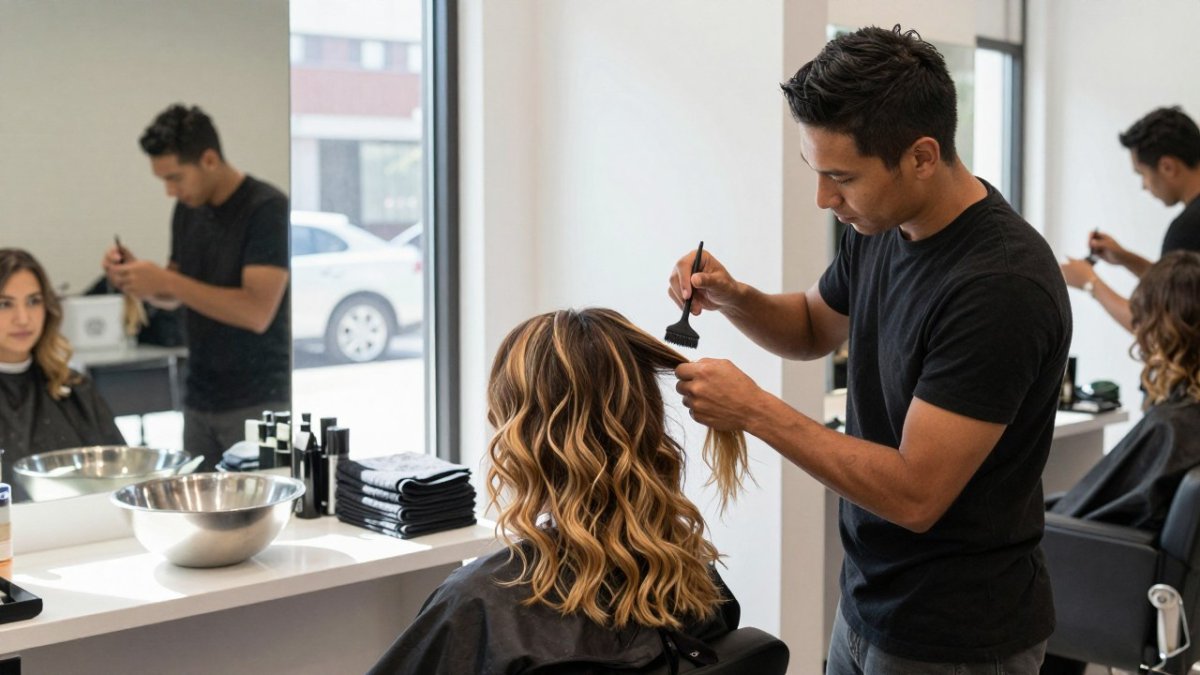
Lowlights can help here. Darker strands woven through gray sections can break up silver patches and soften contrast against a dark base.
Highlights do the opposite job. On mostly gray curls, fine highlights add dimension so the silver does not look flat.
Placement decides everything. Color woven along the coil blends naturally.
Watch out: heavy foil work on fine curls can cause breakage where the foil folds.
What Gray Blending for Curly Hair Looks Like Before and After
Gray blending results on curly hair often show softer contrast and more shine, though the curl pattern should look the same. The result is typically not instant or uniform, and the timeline depends on your starting point.

What changes, and when
Immediately after the appointment: contrast softens and tone looks cooler, but curls may sit slightly looser until the first wash. Demi-permanent and toning formulas need a wash or two to settle into their final shade.
At 2 to 3 weeks: clumping and definition return as the cuticle settles, and the blend reads more natural because the color has faded slightly into the curl pattern.
At 6 to 8 weeks: gray roots begin to show against a dark base, which is why the maintenance schedule matters as much as the initial application.
How results differ by starting point
Dark base, scattered gray: silver patches become soft ribbons instead of bright streaks. The change is most visible at the hairline and crown, where gray usually concentrates first.
Half gray, half dark: the line between colors blurs, so regrowth looks intentional rather than neglected. This is the group that benefits most from lowlights, because the technique breaks up the boundary between pigmented and gray strands.
Mostly silver, dry texture: toner restores cool tones and curls clump again after a moisture treatment. Without aftercare, silver curls can read as yellow and flat within a few weeks.
What most before-and-after photos hide
The "after" photo depends on styling as much as color. A defined wash-and-go shows the blend best, while a brushed-out or heat-styled photo can make the same color work look patchy. Ask to see results on hair that has been styled the way you actually wear yours.
Watch out: a before-and-after that shows dramatically tighter curls after coloring is usually a styling difference, not a color result. Lightening tends to loosen curl pattern, so any claim that color improved definition should be treated with skepticism.
Realistic limitations
Gray blending is not gray coverage, and it is not permanent. Demi-permanent and toning formulas fade, lowlights grow out, and no technique will make coarse gray strands behave exactly like pigmented hair. Clients who expect a soft, evolving blend tend to be more satisfied than those expecting a fixed result. If full, permanent coverage is the goal, that is a different service with different trade-offs, and it is worth discussing before the first application.
Gray Blending for Curly Hair at Home: What You Can and Cannot Do
At-home gray blending for curly hair is limited to maintenance, not transformation. You can tone, gloss, and care for color between appointments. You should not lighten or do full color corrections alone.
Safe at-home tasks:
Color-depositing masks or glosses to refresh tone
Purple or blue shampoo to keep silver cool
Deep conditioning once a week
Root touch-up spray for a quick fix before an event
Tasks to leave to a professional:
Any lightening or bleach
Sectioning color through tight coils
Correcting a patchy result
Transitioning from permanent dye to natural gray
The patch test matters. Testing any hair dye on a small area before full use is a sensible precaution, even for products labeled gentle.
Maintenance Schedules and Curl-Safe Aftercare
Plan on a tone refresh every 4 to 6 weeks and a full color appointment every 8 to 12 weeks. Curls hold color well, but gray roots show faster against a dark base.
Between visits, protect the investment:
Wash with sulfate-free shampoo twice a week at most
Use a leave-in conditioner on damp curls
Sleep on satin to reduce friction
Book a trim every 8 to 10 weeks to keep ends from splitting
For styling guidance that keeps definition after a color service, our step-by-step curly hair styling guide walks through the full routine.
Pricing depends on hair length, density, and the technique you choose. For current prices or a quote, please visit our website.
Book a Curl-Specific Gray Blending Consultation
A curl consultation is where gray blending succeeds or fails. We assess your pattern, porosity, and gray percentage before touching color. Then we build a plan you can maintain.
Coming with dry, unstyled hair and photos of results you like can help. Consider asking these questions before you commit:
Which technique suits my curl pattern?
Will this use bleach, and if so, how much?
How often will I need a refresh?
What will this cost in total?
If you are preparing for your first visit, read our guide to hair color consultation preparation and the questions to ask at a curly hair consultation. When you are ready, book your appointment online.
Gray blending on curls is a skill, and not every salon has it.
Frequently Asked Questions
What happens to curly hair when it goes gray?
Gray strands lose melanin, and that change often comes with a shift in texture. Many people find silver curls feel coarser, drier, and more prone to frizz because the cuticle holds less moisture. Curl pattern can loosen or tighten unevenly, so you may get a mix of textures in the same head of hair. This is why gray blending on curly hair works best when the color choice and aftercare are matched to the new porosity rather than to how your hair behaved before.
Can you blend gray curly hair without bleach?
Yes. Demi-permanent color, glosses, and toners can deposit neutral or cool tones over gray strands and soften the contrast against your dark base without lifting pigment. The trade-off is longevity: these formulas fade over roughly four to six weeks and will not lighten dark hair. If your goal is a lighter overall look, some lightening is usually required. Ask your colorist to walk you through what each option can and cannot do for your starting color.
Are highlights or lowlights better for blending gray on curls?
It depends on your starting color and how much gray you have. Highlights add lightness and help silver strands sit inside a lighter overall pattern, which works well when gray is above roughly 30 percent. Lowlights add depth back into hair that has gone too pale or washed out, and they help a dark base stay visible. Many curl-friendly plans combine both, with placement chosen so color follows the spiral rather than cutting across it.
How do you care for curly hair after gray blending?
Treat the first two weeks as recovery time: skip clarifying shampoos, use a sulfate-free cleanser, and add a weekly moisture mask. Gray hair is typically more porous, so a leave-in conditioner and a light oil on ends help hold curl definition. Refresh with water and a little styling cream rather than re-washing daily. Book a gloss or toner refresh every six to eight weeks to keep neutral tones from turning brassy, and ask your stylist to show you the exact products they used so you can repeat the routine at home.
Comments