
7 Layered vs Blunt Bob Rules for Fine Hair
Last Updated: November 1, 2026
Quick Summary
The layered bob vs blunt bob choice for fine hair depends on whether you want denser ends or more movement. A blunt bob keeps every strand at one length so the perimeter reads as a solid, heavy line, while a layered bob removes weight in steps so ends separate into softer, piecey sections. The finer your hair, the fewer and longer your layers should be.
A blunt bob concentrates weight at the perimeter, making fine hair look fuller because light hits a continuous line.
Layers add root lift and movement but can leave the last two inches of thin hair looking wispy.
Soft layers sit mostly in the front and around the face, with the back left closer to one length.
A sliced bob point-cuts blunt ends for texture, keeping density while gaining a little movement.
For a blunt bob, focus on smoothness and shine so the perimeter line stays crisp.
Table of Contents
Layered Bob vs Blunt Bob for Fine Hair: The Core Difference
The layered bob vs blunt bob decision comes down to one question: do you want your ends to look denser, or do you want your hair to move?
For fine hair, that single structural choice changes everything about how thick your hair appears. The difference in the mirror is rarely subtle.
Here is what most guides get wrong: they treat layers as a universal upgrade. They are not.
The American Academy of Dermatology's guidance on hair structure and density explains that density (how many strands per square inch) and strand thickness (the diameter of each strand) are separate traits.
How Each Cut Changes Density and Movement
A blunt bob concentrates weight at the perimeter, which is why fine hair looks fuller in it.
Layers do the opposite. They create shorter sections that sit on top of longer ones, which adds lift at the root and movement through the mid-lengths. The trade-off is sparse ends.
Think of it as a budget. Fine hair has a limited amount of visual mass, and you are deciding where to spend it: at the ends (blunt) or at the root and mid-shaft (layered).
Blunt Bob Characteristics and Benefits for Fine Hair
The blunt bob is the strongest density play available to fine hair.
Mathilde Heather
What it delivers:
Maximum visual density at the perimeter, where fine hair usually looks weakest
Sleek lines with minimal styling effort, since the shape holds itself
A polished finish that photographs well and survives humidity
The honest limitation: a blunt bob is a shape, not a style. It sits still. If you want swing and movement, you will fight it every morning.
Watch out: a blunt cut on very low density hair with a weak perimeter can look stringy rather than full, because there is no cross-layer to create depth.
Layered Bob Characteristics and Benefits for Fine Hair
Layers solve a different problem: flatness. A layered bob lifts the root and breaks the silhouette into piecey sections, so fine hair gains movement and texture instead of sitting close to the scalp.

Where layers earn their place:
Root lift on hair that falls flat by midday
Movement through the mid-lengths, especially on natural wave
Weight removal for fine hair that has plenty of density but no body
The catch is maintenance. Layers need styling to show up. Left to air-dry with no product, a layered bob can collapse into a shapeless version of itself, and the ends will look thinner than they did before the cut.
Should Fine Hair Be Cut in Layers?
Yes, fine hair can be cut in layers, but only when the layers are placed to add volume rather than remove the density you already have. The blanket rule "fine hair should never be layered" is outdated. The real rule is about placement and amount.
Soft Layers vs Pronounced Layers
Soft layers sit mostly in the front and around the face, with the back left closer to one length. They add movement without thinning the perimeter.
Pronounced layers are cut shorter and deeper through the crown and back. Balancing these structural demands requires careful consideration when choosing a haircut to ensure your natural wave pattern remains supported rather than depleted.
A useful rule of thumb: the finer your hair, the fewer and longer your layers should be.
Best Bob Haircuts for Fine Hair by Density and Texture
Match the cut to your hair, not to a photo on your phone. The mistake most guides make is treating "fine hair" as one category.
Before you look at a single inspiration photo, assess yourself honestly:
Density check: Pull your hair into a ponytail. If you can easily see scalp through the hair at your temples and crown, you are low density. If the ponytail feels substantial and scalp is hard to spot, you are medium to high density.
Strand check: Roll a single shed strand between your fingers. If you can barely feel it, you have fine strands. If it feels like sewing thread, you have medium to coarse strands.
Texture check: Let hair air-dry with no product. Straight, wavy, or curly changes how layers behave.
Fine hair generally falls into a few practical profiles before a shape is recommended:
Hair Profile | Best Bob Shape | Why It Works | Avoid |
Low density, straight fine strands | Blunt chin-length bob, one length | A solid perimeter reads as fullness; no cross-layers to expose thin ends | Heavy short layers, deep crown graduation |
Medium density, straight fine strands | Blunt or sliced bob with soft face-framing | Density at the ends, gentle movement at the face | Deep crown layers that thin the back |
High density, fine strands, straight | Layered bob with long, soft layers | Removes bulk without stripping the perimeter; adds root lift | One-length heavy bob that collapses flat |
High density, fine strands, natural wave | Layered bob with graduated shape | Weight removal plus root lift; wave gives layers something to grab | Blunt bob that turns into a triangle |
Fine hair with sparse, thinning ends | Short blunt bob above the chin | Removes the thin section entirely and resets the perimeter | Long layers past the jaw that leave wispy tips |
A sliced bob sits between the two camps. The stylist cuts blunt ends but slices into them with point-cutting for texture, so you keep density and gain a little movement. It is the best compromise for fine-but-dense hair that wants swing without sacrificing the perimeter line.
For fine hair with a natural wave, ask for graduated layers, shorter at the crown, longer toward the nape, rather than uniform layers.
If you are unsure which group you fall into, a stylist can assess your density and texture in person and recommend a shape that fits. You can also read about the best hair stylist in San Francisco for hair-type-specific advice.
How to Make Fine Hair Look Thicker With Either Cut
Thickness is mostly a styling outcome, and both cuts can deliver it if you stop weighing your hair down. Fine hair responds badly to heavy product, so the goal is lift and separation, not coating.
What actually works:
Apply root lift spray or mousse to damp roots only, then blow-dry upside down
Use a round brush at the root for two to three seconds per section to set volume
Keep conditioner on the mid-lengths and ends, never the scalp
For a blunt bob, focus on smoothness and shine so the perimeter line stays crisp. For a layered bob, focus on separation so the piecey sections read as texture instead of frizz.
Bob Haircut Styling Tips for Fine Hair
Styling effort is where the two cuts really separate, and it is also where most fine-hair advice goes wrong. The goal is never to coat your hair into submission, it is to create lift at the root and separation at the ends without adding weight. Fine hair responds badly to heavy product, so the routine below is built around lightweight formulas and directional heat.
For the blunt bob (5-8 minutes):
Towel-dry to about 60 percent, then apply a lightweight root-lift spray or mousse to the roots only, never the ends.
Rough-dry upside down for 30 seconds to lift the root, then flip upright.
Use a flat brush or round brush to smooth the perimeter straight down, keeping tension so the ends align into a clean line.
Finish with a pea-sized amount of lightweight serum on the ends only, then a quick pass with a flat iron on the perimeter if you want sharp edges.
Skip dry shampoo on day one; use it only on day two at the root to absorb oil before it weighs the perimeter down.
For the layered bob (10-15 minutes):
Apply root-lift spray to damp roots and a lightweight texture spray to the mid-lengths.
Rough-dry upside down until 80 percent dry, this is where most of your root lift comes from.
Section the top and use a round brush to curve the shorter layers under or flick them out, directing heat from root to tip.
Leave the top alone after styling; over-working the crown flattens it.
Finish with texture spray on the ends only, holding the can 8-10 inches away so you get separation without stiffness.
Heat styling matters more with layers, since the shape depends on direction.
A practical product rule for fine hair: if a product promises "smoothing" or "nourishing," use it on the ends only. If it promises "lift," "texture," or "volume," use it at the root or mid-length.
If you want to see how these shapes actually sit on real heads before you commit, browse recent bob work from a stylist or salon. You can also explore the salon services available for cutting and styling.
Telling Your Stylist Exactly What You Want
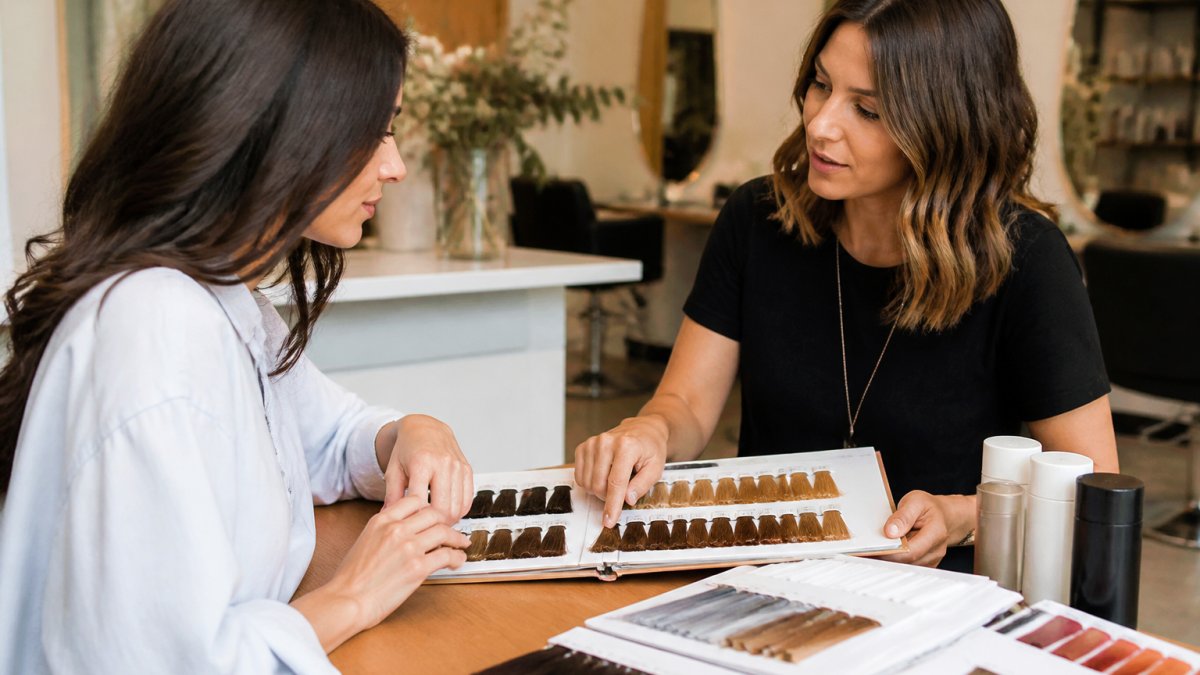
Bring photos, but bring the right words too. "A layered bob" means different things to different stylists, and vague language is how people end up with a cut they did not ask for.
Use this script at your consultation:
"I want a blunt bob, one length at the perimeter, no layers through the back."
"I want a layered bob, but keep the layers long and soft, front only."
"I have fine hair, so I want density at the ends. Please do not thin them out."
Ask one more question: how often will this shape need a trim to stay sharp?
Before you commit to a bob, it helps to consider which shapes suit your face shape, because the same cut can flatter one jawline and fight another. When you are ready to sit in the chair, you can book your appointment directly through Hairplay.
Frequently Asked Questions
Does a blunt bob make fine hair look thicker?
A blunt bob usually makes fine hair look thicker because every strand ends at the same length along the perimeter. That solid line of blunt ends creates a dense, sharp edge, so the bottom of the cut reads as one full mass instead of tapering away. If your hair is sparse at the ends or you can see through the last inch, a one-length cut hides that best. Ask your stylist to keep the perimeter strong and skip heavy texturizing.
Will shorter layers in a bob cut make fine hair look fuller?
Shorter layers can make fine hair look fuller, but placement decides whether they help or hurt. Layers that start around the chin or cheekbone lift the root and add movement, which reads as volume. Layers cut too short or too deep remove weight from the ends and can leave the perimeter looking thin and piecey. For fine hair, ask for subtle layers concentrated near the face and crown, with the length left mostly intact.
Is a layered bob easier to style than a blunt bob?
A blunt bob is generally easier to style because the even perimeter falls into place with a quick blow-dry and a flat brush. A layered bob needs a round brush or a light pass with a styling tool to shape the ends and stop them from separating. If you want low styling effort, go blunt. If you want movement and are willing to spend a few extra minutes, layers pay off.
Can I have a blunt bob with fine hair that has natural wave?
Yes, but expect the wave to soften the line. On straight fine hair a blunt bob keeps sharp, sleek edges. On naturally wavy fine hair, the same cut springs up shorter and the perimeter can look uneven unless your stylist cuts it dry or accounts for shrinkage. Ask for a blunt or sliced bob cut to your wave pattern, and plan on a trim every six to eight weeks to keep the shape clean.
Fine hair gives you less margin for error, which is exactly why the consultation matters more than the photo. At Hairplay, we cut for your density and texture first, then style it so you can recreate it at home, with services covering long, curly, straight, and short hair and scheduling built around your week. Get started with Hairplay and leave with a bob that looks full on day one and still looks intentional on day thirty.
Comments